

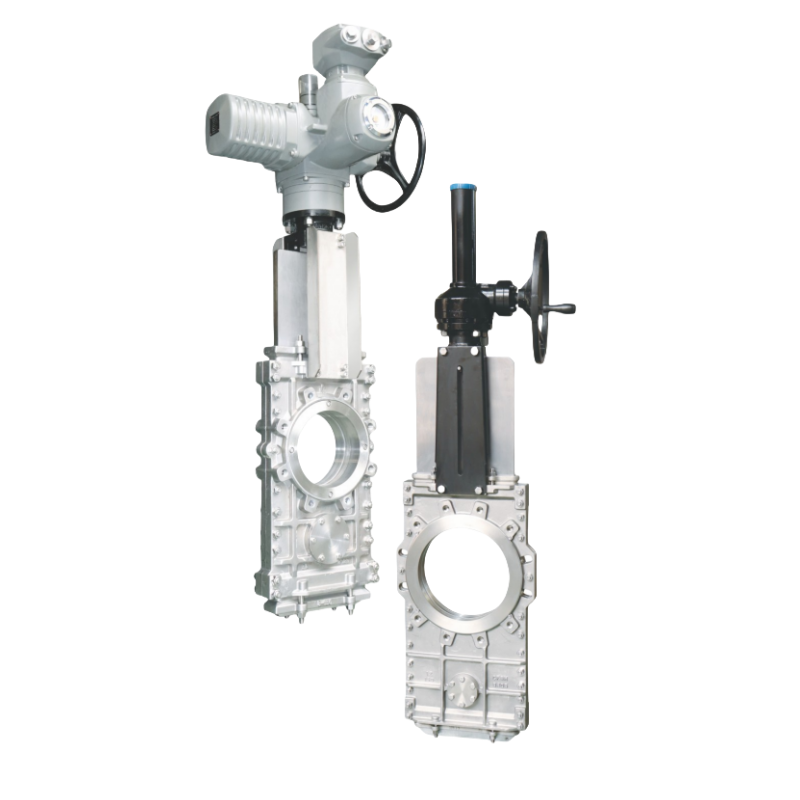
Construction and intended duty
This page covers a 304 stainless steel, electrically operated wafer through-conduit knife gate valve. A transmission moves the gate linearly for an isolation duty accepted for the application. The opening in the through-conduit gate aligns with or moves away from the flow passage. Confirm the actual gate, seat and packing arrangement from the supplied sectional drawing.
Electric operation is not proof of throttling capability
Receiving a control signal or stopping part-way does not establish suitability for continuous throttling. Check the gate and seat design, flow data, differential pressure, erosion, vibration and actuator duty. Closed-loop temperature or pressure control also requires measurement and a control system; the valve alone does not precisely control every process variable.
Materials and sealing
Specify the 304 body material together with the gate, seat and packing materials. Select soft or metal seating for the fluid, temperature and required leakage acceptance. If a compensating seat or multilayer seal is required, list it separately in the enquiry so it can be matched to the supplied design.
Slurry, installation and maintenance
A through-conduit passage can assist material movement, but does not guarantee freedom from blockage by any particles, fibres, deposits or crystals, nor zero pressure loss. Supply solids concentration, particle size, fibre and abrasion information. Allow the full gate stroke, actuator envelope, guards and packing access, and support the pipe independently. Isolate and depressurise safely before maintenance.
Information for quotation
Provide fluid, temperature, pressure, maximum shutoff differential, operating frequency, connections and installation drawing. Specify power, control, feedback, protection and loss-of-power requirements. On/off and modulating packages must be checked separately; a standard electric actuator is not assumed to fail closed. Obtain configuration-specific dimensions, ratings, test requirements and wiring information.
Frequently asked questions
Can it remain partly open for flow control?
Only after the valve design and duty have been checked for throttling, erosion, vibration, differential pressure and control performance.
Does through-conduit construction prevent all slurry blockages?
No. Solids, fibres, deposits, crystallisation and operating conditions must be evaluated.
Will it automatically close on power failure?
Not necessarily. Confirm the failure position, any stored-energy return mechanism and the actual control scheme.


