

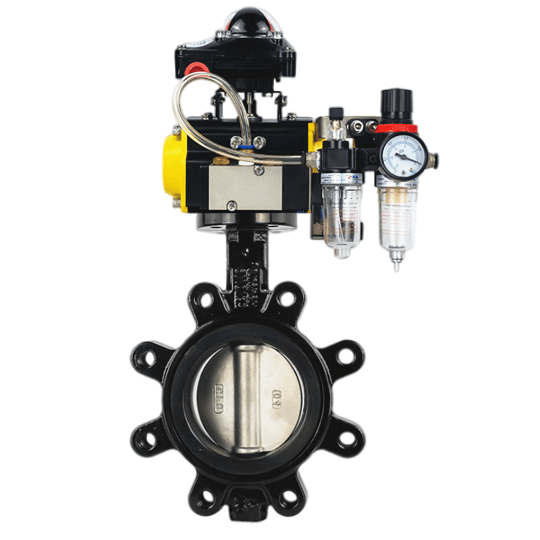
Construction and duty
This page covers a resilient-seated concentric butterfly valve with a QT450 ductile iron body and lug connections. The disc rotates for an accepted pipeline duty; lever and pneumatic packages are selected separately. QT450 identifies the body, not the material of every disc, shaft, seat or seal.
Lining does not remove compatibility checks
Select the seat, disc, shaft, seals and body for the fluid, concentration and temperature. Include permeation, wear and possible leakage paths in the material review. If the installation requires explosion protection, specify the applicable area classification and certification separately from the stem-retention design.
Lugs, flanges and installation
Lugs permit individual flange bolting, but do not automatically establish pressure-rated end-of-line service. Confirm that duty, direction and rating separately; isolate safely before removing downstream pipework. PN, Class and JIS designations are not directly interchangeable: check drilling, faces, face-to-face and disc clearance. Use or omit gaskets according to the actual seat and installation instructions, not a blanket rule. Align and independently support the pipe. Lug connections do not eliminate vibration, bending or external load effects.
Sealing and operating limits
Bidirectional closure, allowable leakage and shutoff differential require the actual seat, test standard, medium, duration and direction. A resilient seat alone does not prove universal zero leakage, service life or a common pressure/temperature/size range. Continuous control needs flow data, useful opening, differential, cavitation and actuator duty checks; intermediate positioning alone is not precision control.
Quotation and documents
Provide fluid, temperature, pressure, shutoff differential, size, flange standard, cycling and available space. Obtain materials, dimensional/sectional drawings, seat installation instructions, closure tests and torque data. Match mounting dimensions, shaft and torque: an ISO 5211 designation alone does not guarantee bracket-free direct mounting of any actuator. Unconfirmed ratings and certificates are not universal supply specifications.
Pneumatic failure response and accessories
Double-acting operation uses air in both directions; loss of air does not inherently guarantee that the valve stays put. Check load, circuit, leakage and any locking arrangement. A spring-return package may be assembled for fail-open or fail-closed duty; confirm orientation, available spring torque and failure conditions. Size at the minimum available air pressure rather than adopting a universal supply range. Positioner signals, feedback, solenoids and manual override are package-specific. Air filtration, regulation and any lubricator must follow both actuator and positioner instructions; oil mist is not assumed suitable for every package.
Frequently asked questions
Does a lug body automatically allow pressurised end-of-line service?
No. Confirm the specific design, direction and end-of-line rating, and isolate safely before dismantling pipework.
Does a liner mean metal corrosion can be ignored?
No. Check potentially wetted parts, isolation boundaries, permeation, damage and leakage risks.
Will a double-acting actuator hold position on air failure?
Not inherently. Verify the load, pneumatic circuit and locking devices. Fail-open, fail-closed or fail-in-place behaviour must be specified for the complete package.


