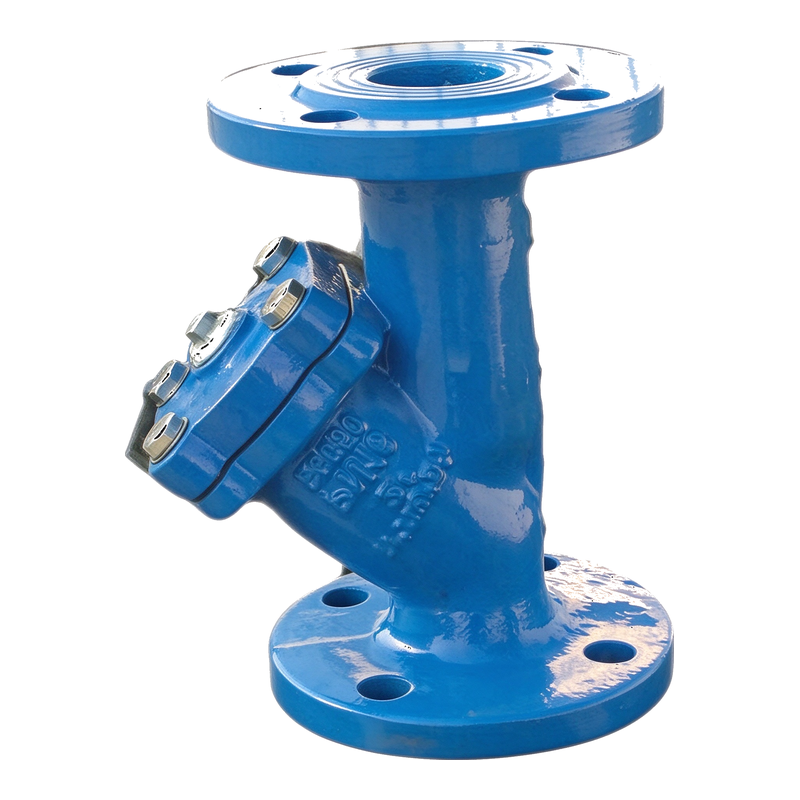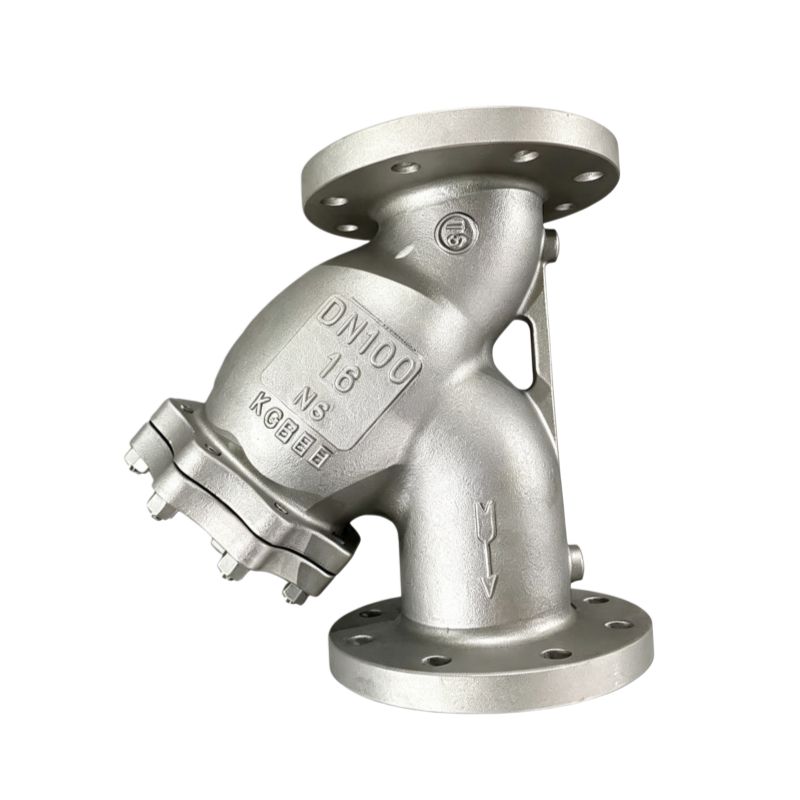
Series selection options
| Body material | QT450 ductile iron |
|---|---|
| Nominal size | Multiple sizes available for US-standard piping |
| Pressure class | Class150(150LB) |
Smaller or larger sizes outside the listed range can be evaluated for custom manufacture and tooling. The listed sizes are not the limits of custom capability; supply is subject to an agreed design and quotation.
Class 150 ductile-iron Y-strainer for US-standard piping
Technical specifications — reference options; select against the actual product data
| Item | Specification |
|---|---|
| Nominal size | Multiple sizes available for US-standard piping |
| Pressure class | Class150(150LB) |
| Body material | QT450 ductile iron |
| Screen material | Selected for the filtration requirements |
| Filtration fineness | Customized to process requirements; mesh options available |
| Service media | Water, oils, gases and steam |
| Fluid temperature | Selected for the service conditions and configuration |
| Connection | Flanged connection, ANSI system |
| Standards system | ANSI/ASME system |
Upstream equipment protection in US-standard piping
Y-strainer construction and operation
Fluid enters the inlet, passes through the screen and leaves through the outlet. Solids are retained inside the screen.
The inclined screen provides a relatively large filtration area and relatively low pressure loss.
Accumulated debris can be removed through the lower drain cover or by removing the screen, without removing the entire strainer.
Different screen mesh counts can be selected for the required process filtration.
Ductile-iron body: strength and toughness
Strength: Ductile iron has higher tensile strength than grey iron, supporting pressure-containing applications.
Toughness: Spheroidal graphite gives the material ductility and impact resistance, reducing brittle-fracture susceptibility in buried service or repeated handling.
Castability: Suitable for complex cast components such as strainer housings.
Cost: Combines the properties of ductile iron with lower cost than forged steel or stainless steel for bulk piping applications.
Class 150 piping connections
Pressure class: Class 150 (150LB), for the corresponding US-standard flanged piping system.
Flanged: ANSI flange connections for compatible US-standard piping.
Project scope: North American, export and other projects designed to US standards.
Screen material: The screen is stainless steel, with mesh count selected for the service.
Key features
The inclined-screen arrangement is compact, with a relatively large filtration area and relatively low pressure loss.
Retains pipeline debris to protect downstream pumps, valves and instruments.
Ductile-iron body combining strength and toughness for pressure-containing service.
Class 150 design with flange connections for compatible US-standard piping.
The screen is accessible for removal and cleaning, helping reduce maintenance costs.
Filtration fineness can be customized for the required process cleanliness.
Applications and selection
Debris retention upstream of pumps, valves and flowmeters.
Piping filtration for general media such as water, oils, gases and steam.
North American and other US-standard projects.
Piping systems requiring US pressure-class and flange specifications.
Filtration fineness: Select the mesh count for downstream equipment, balancing particle retention against pressure loss.
Fluid and temperature: Select body and screen materials for the fluid and temperature. Check the screen temperature capability for steam service.
Pressure class: Select the Class designation for the piping duty and check the actual flange standard.
Installation direction: Follow the body flow marking and orient the screen for effective debris retention and draining.
Flange standard: The flange class and facing, such as RF or FF, must match the piping.
Frequently asked questions
Selection summary
This Class 150 ductile-iron Y-strainer uses an inclined screen to retain pipeline debris and a ductile-iron body for strength and toughness. Before ordering, have qualified personnel confirm the configuration for the fluid, temperature, filtration duty and piping standard.